Administrator Oz: CMS must ‘shut the whole country down’ to stop DME fraud ‘All the people who are already selling products can continue to sell products until we check them out'

By Liz Beaulieu, Editor
Updated 10:00 AM CST, Fri February 27, 2026
Editor’s note: At press time on Friday morning, industry stakeholders were still analyzing CMS’s announcement. This is a developing story. Check www.hmenews.com for updates.
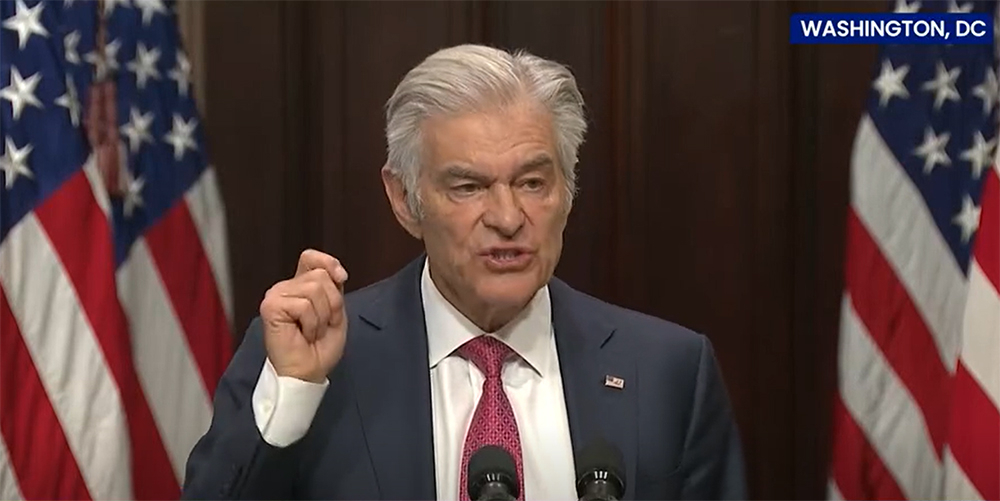
WASHINGTON – CMS Administrator Mehmet Oz says a six‑month nationwide moratorium on new Medicare enrollments of DMEPOS medical supply companies will give the agency the time and capacity it needs to tackle what it believes is billions of dollars in fraud, waste and abuse.
“Part of the reason for this moratorium is it gives us time to be able to deal with these issues that have become massive,” he said during a Feb. 25 press conference. “And if we just shut down South Florida, they all flee to California and Texas, so we have to shut the whole country down. This unfortunate necessity is going to allow us to get on top of what we believe is billions of DME fraud.”
Oz was joined by Vice President J.D. Vance, whom President Donald Trump recently tapped during the State of the Union to lead the administration’s “war on health care fraud.”
DMEPOS cited as a prime target for Medicare fraud
Oz said DMEPOS remains a “great target” for criminals who steal Medicare beneficiary numbers and “pretend” to ship products they never deliver. He pointed to “Operation Brace Yourself,” a 2019 scheme involving $1.1 billion in fraudulent brace orders.
“There’s no cost of goods sold, there’s no inventory, there’s no payroll,” he said. “No one works in the place – it’s empty – but they generate millions of dollars of fake bills.”
He emphasized that the impact extends beyond taxpayer dollars.
“Imagine you’re on an insulin pump and someone steals your number and orders an insulin pump fictitiously, bills Medicare and then you come and try to get this to deal with your diabetes,” he said. “You don’t get it. That actually happened. And what happens to those patients is they don’t know if their blood sugar is too high or so low, and they might die. That’s the risk we’re allowing by not taking this seriously.”
CMS highlights scale of the problem
Oz underscored the breadth of the issue by comparing DME supplier density in South Florida to a fast‑food giant. He said there are twice as many DME suppliers in South Florida as McDonald’s locations.
“Wow,” Vance reacted.
“And that’s not because Sec. Kennedy is closing down McDonald’s, that’s because the fraud is so massive that’s it’s easier to open one of these suppliers than open a bank account,” Oz said.
CMS says legitimate suppliers and beneficiaries will be unaffected
Oz stressed that the moratorium is designed to halt new fraudulent activity without disrupting access to existing care. He maintains that the moratorium “will not touch the people who need these services” – i.e. Medicare beneficiaries.
“We have designed the system so that all the people who are already selling products can continue to sell products until we check them out, but there will be no new DME enrollments and no new ownership changes – all the things that fraudsters have done historically will be blocked,” he said.
CMS crowdsources how to ‘crush fraud’
Oz ended the briefing by inviting providers, beneficiaries and stakeholders to help shape the agency’s fraud‑fighting strategy over the next six months.
“We want your input on how to prevent, detect and respond to fraud in government-funded health care,” he said. “Whatever ideas you have, we’re interested in (them). Our goal is to supercharge program integrity over the next six months. So, we’ve put in a request that means providers, suppliers, payers, tech companies, patient advocates, beneficiaries – if you see fraud, let us know.”
He encourages people to share ideas or report suspected fraud by visiting cms.gov/fraud or calling 1‑800‑HHS‑TIPS.
Key additional information:
- For a CMS FAQ on the moratorium, go here.
- AAHomecare’s initial response to the moratorium: “We appreciate CMS Administrator Oz's demonstrated commitment to preventing criminals from enrolling in the DMEPOS program,” said Josh Marx, CEO of Medical Service Company and chairman of the board for AAHomecare. "We hope to work with CMS to strengthen enrollment practices without harming patients and communities by mandating a complete halt to new enrollments for existing providers."
- To read an initial response to the moratorium by VGM & Associates go here.
- To read an FAQ from Brown & Fortunato go here.
- Share your thoughts with HME News editors at editors@hmenews.com.

Comments